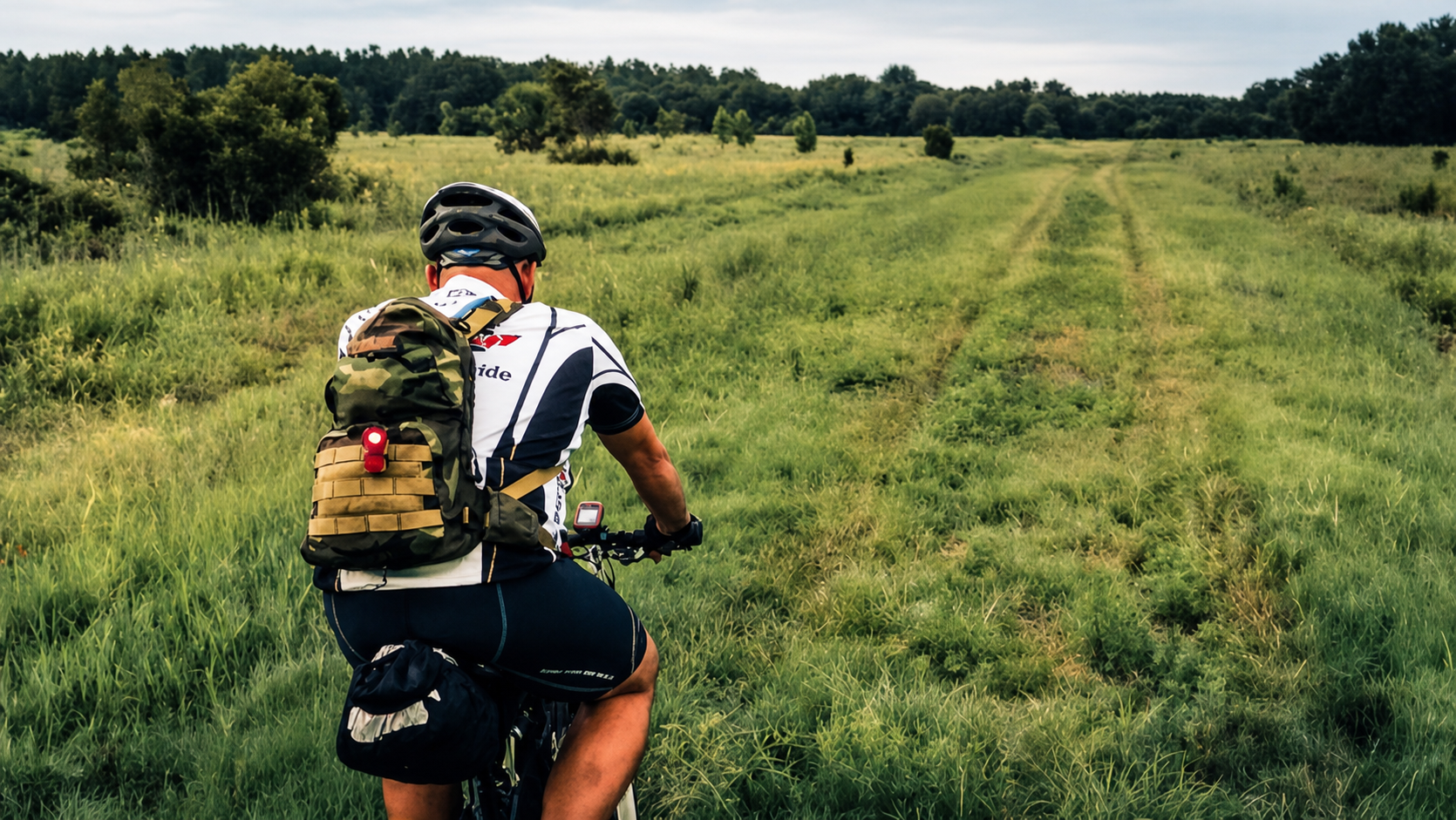
Every long rider eventually meets a stretch of road or trail that feels bigger than the plan: a headwind that will not quit, rough ground after dark, a loaded bike that suddenly feels twice as heavy, or a mind that has decided it would rather be anywhere else. The answer is not always to suffer harder. Most of the time, it is to notice what is actually happening and make the next useful decision.
These are ten practical resets for long rides and bikepacking days. They work best when the basics are already in place: reasonable training, a bike that fits, food and water you can tolerate, and equipment suited to the route. They are not a substitute for medical care or good judgment. Stop and get help for chest pain, fainting, confusion, severe heat illness, a crash, or pain and numbness that do not ease.
1. Stay present and work the next piece
When a difficult moment shows up, do not negotiate with the entire remaining route. Bring the horizon close. Make the next dirt section, the next store, the next climb, or the next patch of shade the only job that matters. Small goals and small wins chip away at the bigger picture when the whole thing feels too big to swallow.
It also helps to remember why you are out there. Look up, take in the weather, the sounds, and the place you are moving through. A hard moment is still part of the ride; it does not have to become the whole story.
2. Manage the story you tell yourself
Low points get louder when we repeat them to ourselves. Instead of feeding the thought that the day is ruined, acknowledge the discomfort and return to the next task: eat, shift, roll to the next landmark, or get a layer on. Keep the internal talk useful.
That does not mean hiding a real problem. If you are riding with others and need food, water, a break, or help, say it early and plainly. Good partners make better decisions with good information.
3. Feed and hydrate before calling it quits
Sometimes a bad attitude is simply the body asking for something. When I get a case of the quits, a quick source of calories, water, and the right amount of electrolytes can change the whole equation. Carry food you actually want to eat when you are tired, not just food that looked good in the store.
Do not wait until you are empty to start paying attention. A small snack, a drink, and a minute in the shade are usually easier than trying to claw your way back from a deep hole.
4. Slow down when your pace is the problem
There are days when the only real problem is that you are riding beyond the pace you can hold. Shift down, spin easier, and let the effort match the terrain. A short stop, a nap, or a slower hour can recharge both the body and the mind.
There is no prize for turning every climb into a test. On a long ride, the goal is to keep enough in reserve for the miles that are still coming.
5. Do not stop by accident
There is a fine line here. A break can be the answer, but too many unplanned stops can make it harder to get rolling again. Rather than riding at 90 percent and repeatedly blowing up, try riding closer to 70 percent and staying in motion more consistently.
When you do stop, give the stop a job: refill bottles, eat, adjust a bag, cool down, solve a mechanical, or rest your eyes for a few minutes. Then get moving again before the break turns into a rut.
6. Keep it light – physically and mentally
Long-distance travel comes down to power versus weight. Extra gear costs energy all day, especially when the route gets sandy, steep, or slow. Pack what the conditions require, but do not bring every fear with you.
The same idea applies upstairs. Heavy thoughts, grudges against the route, and a bad forecast replayed over and over all take energy. Keep the load manageable, on the bike and in your head.
7. Let the course tell you when to go fast
Speed is sometimes exactly what breaks up the monotony and gets a rider moving again. But the course should set the pace. Fast pavement, a tailwind, and smooth hardpack are gifts; loose sand, heat, steep grades, and rough trail ask for patience.
Learn to use the terrain instead of fighting it. Push when the route gives you an opening, back off when it takes one away, and you will make better time over the full day.
8. Do not bite off more than you can chew
Do not keep repeating, “I have 80 hard miles to cover in six hours.” That is a good way to make the day feel impossible. Say, “I am going to finish this next dirt section,” or “I have three miles to the top.” Tiny targets turn a big ride into a sequence of reachable ones.
This is not lowering the standard. It is breaking the work into pieces you can actually do well.
9. Keep it real
The worst planning mistake is overestimating what you can do on the day you are actually having. When you set a distance or a finish time, account for resupplies, rests, weather, navigation errors, and mechanicals. Then be honest about your current fitness, your energy, and the route in front of you.
A realistic adjustment is not failure. It is how you keep a hard day from becoming a bad one.
10. Keep a Plan A, B, C, and D
I always have a Plan A, but I also keep a Plan B, C, and D, with each one a little easier than the last. The full route may be Plan A. A closer campsite, a shorter connector, a bail-out road, or a ride home before dark can all be good outcomes when conditions change.
Leaving room to adapt lets you finish the day feeling good about what you did instead of forcing a plan that no longer fits the moment.
Ultimately, the best preparation is to ride enough – including some fully loaded rides – that your body and your expectations match the trip you want to take. Long rides are not won by never feeling rough. They are finished by recognizing the problem early, choosing the next sensible move, and keeping enough in the tank to enjoy what comes after it.